Georgia Tsangaraki
The Field Within: A European Journey of Belonging
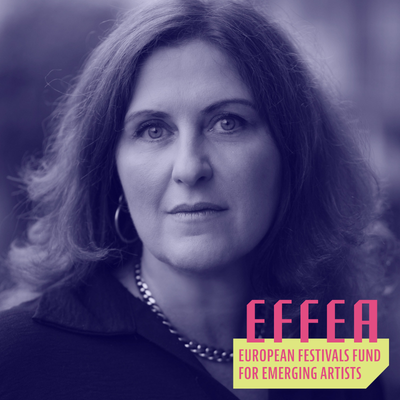
Georgia Tsangaraki, Theatre Director, Actor, Educator & Dramatherapist
©Haris Germanidis
The house where I grew up was in a field. In Athens, yes, but in a field. That's where my grandmother got married, where my mother grew up—in this field in the middle of a big city. In the middle of this antithesis. I always felt different: Athenian but not quite, Greek but not quite. Within the concrete of the metropolis but also full of earth, cisterns, and wells.
After Greece and the National Theatre School, I found myself in England again, for studies. There I felt intrigued, speaking in a language that isn't my mother tongue yet allowing me to express myself better. Interacting with people from all over the world, with theatre as our common ground. Then came travels, along with the process of evolving within cultures and languages that weren't native but gave me inner freedom. Meeting people who came from other homes with fields or concrete walls.
This is how I experience Europe. As a wider inner space that allows me to exist. Like my own field, which I'm discovering little by little, tending it through my work, opening new, exciting pathways of communication and coexistence. These are two words I use frequently in the theatrical approach I've been developing over the past ten years, and which this year I have the opportunity to explore further within the framework of the grant entrusted to me by the European Festival Fund for Emerging Artists. An artistic journey across three countries—Greece, Romania, and Bulgaria—with the aim of creating a ritual space of transformation, where boundaries between the individual and the collective dissolve, and a deeper state of "enthusiasm" is experienced (en-theos= ἐν-θεός, meaning "inhabited by the god").
“This is how I experience Europe. As a wider inner space that allows me to exist. Like my own field, which I’m discovering little by little, tending it through my work, opening new, exciting pathways of communication and coexistence.”
This process of artistic community aspires to transcend individual and cultural differences and barriers, revealing a universal, sacred space of coexistence and creative synergy. Guided by my experience and deep love for ancient Greek drama, I soon followed my need to decode this form of theatre myself. This inspired me to create a practical approach—I could call it a method of training, group coordination, and personal development—that takes as its vehicle the chorus of ancient tragedy. Coexistence and communication are keywords of the method I've named The Spiral Effect, inspired by the spiral as a symbol of continuous movement inward—toward the self—and outward—toward the world.
The project In Between 2, which will be realised this autumn, has as its central axis a series of research workshops to be held at each participating festival. The goal of the workshops is to forge a common language of artistic expression drawing elements from local melodies, rhythmic traditions, and cultural customs, while simultaneously incorporating contemporary practices of musical composition and stage creation. Participants will be guided toward discovering a new mode of performance based on transcending the ego, intensifying presence, and authentic human connection. Conceptually, the project, through the symbolic lens of the god Dionysus—as an expression of nature's untamed and transformative power—will explore the tension between humanity's destructive tendencies and the regenerative, unifying possibilities of the natural world.
I am, by nature, optimistic, so I want to believe that at the heart of the European idea and the vast universe hidden within it lies a deep awareness of the identities and multiple levels of belonging that shape the continent's people. The contemporary artist is not simply an isolated creator; they carry a multi-layered heritage, which, through the art of communication, reproduces and synthesises personal lived experience, local traditions, and national narratives, thereby creating an ever more vibrant European consciousness. Like a breathing spiral, integrating the personal with the collective. Family, the language of the homeland, the social practices of the community, the history of a people—all these shape the creative vision. But the ability to belong to a supranational entity, like Europe, offers a new level of identity—not at the expense of the local, but complementary to it. The European endeavour is not merely a mental construct; it provides tangible facilitation mechanisms such as grants—more frequent nowadays—which, combined with free movement between countries, give the artist the mobility needed to have open communication that transforms into creative force. They can thus network, collaborate, and coexist with other artists and systems, revealing a new kind of cultural alloy: unique hybrid forms of art born from the meeting of different traditions, psychic processes, and aesthetic approaches.
This is Europe to me. A vast field awaiting cultivation by people who communicate in a new language beyond linguistic idioms. By people who revitalise, re-examine, and reinterpret traditions. What we inherit remains alive, transforms, and gains new meaning. The European cultural landscape is not static but an ongoing dialogue that continuously shapes new forms of expression- one that requires sustained structural commitment to remain truly inclusive. I don't see or feel it as a debt. I think it's a natural tendency for artists of Europe, through our work, to write a different message—a message of belonging to something greater without denying what makes us unique- provided European structures continue to nurture the conditions that make this possible.
“This is Europe to me. A vast field awaiting cultivation by people who communicate in a new language beyond linguistic idioms.”
