Dušan Kovačević
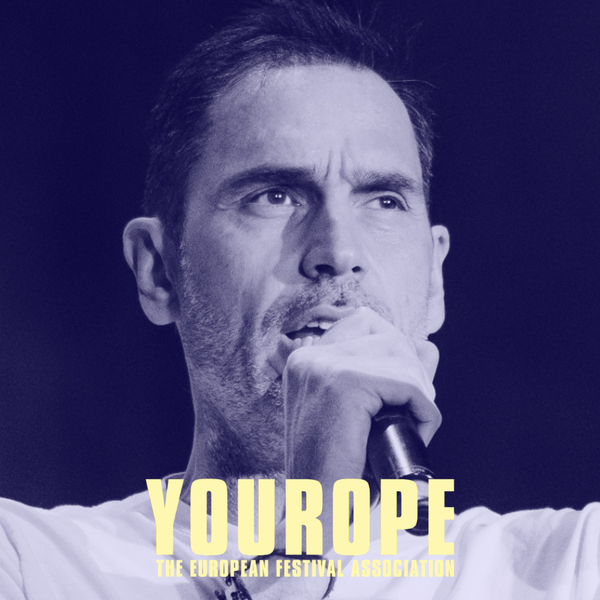
Dušan Kovačević
Co-Founder and CEO EXIT Festival
Coming from Europe, but also from a country that is still not part of the European Union, over the past year I have had a deeply revealing experience of what Europe actually means to me.
This story unfortunately begins with a tragedy. On 1 November 2024, sixteen people lost their lives after the collapse of a canopy at the recently reconstructed railway station in Novi Sad, Serbia. The tragedy triggered widespread public anger over corruption and soon led to massive student and civic protests, creating one of the largest protest movements in Europe’s recent history.
EXIT itself was born out of the student movement against the regime of Slobodan Milošević twenty-six years ago, so naturally we stood with the youth of our country. Because of that support, the festival came under enormous political pressure, from the withdrawal of public funding to direct threats and other forms of intimidation, and was ultimately forced to leave Serbia.
Unfortunately, the story goes far beyond EXIT. Bands, producers, actors, writers and other artists and cultural organisations that supported the students found themselves blacklisted or excluded from parts of the cultural system. Many lost access to public cultural funding, venues, media opportunities and other platforms that depend directly or indirectly on the state. This has brought a majority of Serbia’s independent cultural scene to the brink of extinction. At the same time, new politically controlled cultural initiatives, music events and film festivals are being heavily promoted and funded, as a systematic attempt to replace the free-thinking cultural scene. European and American music-industry media have reported extensively on what has been happening.
When this situation began, EXIT reached out to institutions of the European Union, embassies and leading European governments. And this is where I experienced the feeling I mentioned at the beginning. For the first time, although my own country was effectively forcing me into professional exile, I felt that I was also a citizen of a greater Europe, and I was convinced that this larger European home would stand behind what is right. That feeling brought with it a powerful wave of optimism, belonging and purpose.
Unfortunately, as the months passed and neither the EU nor its member states took concrete action to support Serbia’s independent cultural scene and civil society, that optimism gradually transformed into profound disappointment. Culture in Serbia has existed on the margins for decades. It would not have taken much for Europe to help protect an independent cultural ecosystem and give it the space to survive. But that support did not come. Europe failed an important test in Serbia - the test of defending, in practice, the very values it so strongly declares - freedom of expression, cultural independence, pluralism and democratic participation. But this experience did not make me anti-European or anti-EU. Quite the opposite.
By nature, I tend to respond to problems by trying to build solutions. So instead of simply remaining disappointed, I decided to advocate for something that I believe Europe urgently needs: a mechanism that can protect independent culture when governments, whether in EU member states or candidate countries, attempt to control it through funding, media pressure or other forms of institutional influence.
Artists, festivals and cultural organisations facing such pressure should have somewhere to turn. European cultural funds and institutions should be able to provide an independent lifeline when national systems are being used to silence or marginalise them. With political polarisation, the rise of right-wing movements, and increasing pressure on democratic institutions across different parts of Europe, what happened in Serbia should not be seen simply as a local issue. Similar pressure on culture could emerge elsewhere, and Europe needs to be prepared.
And this brings me to what Europe means to me today. Europe is, unfortunately, not yet the safe home that I once imagined it to be. But Europe is not only institutions or governments. Europe is the collective output of all of us. It is something we continuously create through our choices, our courage, our culture and our willingness to stand up for one another. And if each of us does what we can, Europe can still become what I believe it has the potential to be.
At a time when so much of the world is moving deeper into division, fear, conflict and darkness, Europe has both an opportunity and a responsibility to offer a vision based on freedom, culture, solidarity, human dignity, environmental protection and hope. Not only Europe as a geographical continent or a political project, but Europe as an idea. With the richness of its history, culture, science, philosophy, and diversity, the Europe I believe in has the potential to be a beacon for our world. But what I have realised through this experience is that whether it lives up to that promise is ultimately up to all of us.
Courtesy of YOUROPE - The European Festival Network.
Also published in YOUROPE’s dedicated ’About Europe’ website section.
