Jordi Savall
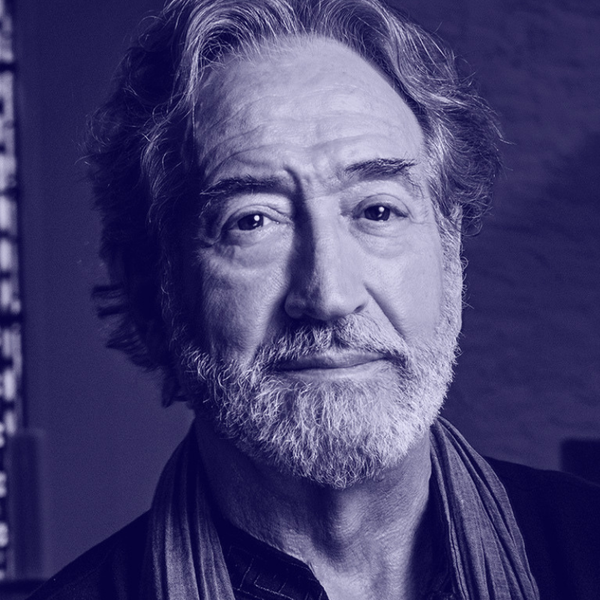
Jordi Savall, Viol Player & Conductor
About Europe's Festivals
Writing this takes me back to 50 years ago when, thanks to festivals, I started working in music, as a viola da gamba soloist and also as a member of my group Hespèrion XXI: Hespèrion XX at that time.
My career would be totally different if festivals had not existed 60 or 70 years ago, festivals like Utrecht Oude Muziek, Le Festival de Saintes, Beethovenfest Bonn, Festival d'Ambronay, Festival van Vlaanderen, Styriarte, Salzburg Festival. All these festivals made it possible that we, young musicians in this style (early music) in this period, had possibilities and could record new projects every year.
I think this is the most important function of festivals today. Europe has a lot of important festivals, and I think they do fantastic work. I go to festivals like Utrecht, Styriarte and Salzburg every year and have done for over 30 years, sometimes with one or two projects, sometimes with more. This continuity is very important for the work and for the possibility of recording and making new projects. The fidelity of the festival is a key point for young musicians. It is something to remember because if a group has one concert and then the next invitation is ten years later, it doesn't help the musicians to make really good work.
As musicians, we have operate in very a specific context today. The concept, the value of the art, has changed a lot through the centuries. Practically until Mozart’s time music was only considered important if it was contemporary. In Lives of Haydn, Mozart and Metastasio, Stendhal said, now we have the greatest composers and music has arrived at the highest point of perfection.
“The ancient Flemish music was only a tissue of chords, destitute of ideas. They made their music as they made their pictures: a great deal of labour, a great deal of patience, and nothing more. (…) The melody of the English is too uniform, if indeed, they can be said to possess any. It is the same with the Russians; and, strange to say, withthe Spaniards. Who could have imagined, that a land so favoured by the sun, the country of the Cid, and of those martial troubadours who were to be found even in the armies of Charles V, should have produced no distinguished musicians? That brave nation, so capable of great things, whose romances breathe such sensibility and melancholy, possesses no more than two or three distinct airs. It should seem, that the Spaniards are not fond of a multiplicity of ideas in their affections; one or two only, but deep, constant, and indestructible.”
- Stendhal, The Lives of Haydn and Mozart With Observations on Metastasio and on the Present State of Music in France and Italy (1818).
But Stendhal was ignorant. He never heard Bach, Monteverdi or Palestrina. The book was written in 1809 and this attitude completely changed 20 years later. Then a young composer and conductor, Felix Mendelssohn Bartoli, conducted for the first time in Berlin an ancient work, a work that was already 100 years old: Bach’s St. Matthew Passion. This was a shock for the audience. It left an incredible impression because at this time people thought music from other periods was not interesting; had less quality.
I must remind you that this idea of the value of music was followed for centuries. Older artists, painters, writers, sculptors and architects discovered the ancient art of the Greek civilisation and accepted the idea that there is no progress in art. They thought there could not be progress when one finds such fantastic creations after 2000 years. At that time musicians did not look at any musical examples, only theory.
Music developed so that with the arrival of every new composer, an older one was forgotten. Monteverdi conducted Il Vespro della Beata Vergine, one of the most beautiful pieces of music in history, once in 1610 - and the next time it was heard was in 1940. The discovery of Mendelssohn's in 1829 took more than 130 years to become normal, for us to become conscious that beautiful compositions are worth listening to away from their own age.
The mark of time is in every composition. Music is composed by composers who use instruments and voices in a certain style. In the 1930s, 40s and 50s we started playing instruments of the music's time; to use what we call today historically informed performances. And then we arrive in our century. Today we have fantastic musicians worldwide that play instruments of the medieval Renaissance, Baroque and Classical periods, and regional instruments.
In Europe, we have an economic union, a currency, we have freedom of movement across most countries, but we don't have a European cultural policy. Every country has its specific cultural policy. People like me, fundamentally are European musicians, I'm Catalan as a person but as a musician I feel European because I speak the language of Europe. The language of Europe is music. It's Monteverdi, Palestrina, Bach, Beethoven – it's every great composition. This had its start in the Ars Nova. Ars Nova was a moment when some great composers invented a new style: music with different voices, counterpoint, harmonies. This evolution made European music totally different from all the music of the rest of the world.
It is important to remember that musicians bring music from ancient times alive again. This demands a lot of research, work and rehearsal. What we aim to do is transmit all the beauty and emotion of these scores to the public today. Like Elias Canetti says, 'music is the real, living history of mankind'. Because when we sing a troubadour song, play a symphony by Mozart, or sing an aria by Bach or Monteverdi, we experience the same emotions as the people who lived in those times.
“The language of Europe is music. ”
When we started rehearsals of Beethoven’s Missa Solemnis with Le Concert des Nations and La Capella Nacional de Catalunya, with 40 singers, and 60 instrumental musicians from all over Europe, the challenge we faced was how to compete with the most important institutional orchestras resident in a single place. We were in an unacceptable economic situation, without local subsidy. This is a real problem because the quality of the groups depends on the possibility to rehearse properly and be present in festivals.
Another problem is the cost of travel. The costs to play at a festival have risen massively this decade. For an ensemble ths can sometimes mean an extra 20,000 or 50,000€. We make contracts with festivals years in advance and cannot change these expenses. Festival administrators need to be aware of the challenges this places on musicians.
This being said, I think that today the quality of music is fantastic and there are a lot of very good ensembles. Every year, we invite talented young musicians to my festival in Santes Creus and also to Festival Fontfroide. In 2024 we invited musicians from Ukraine to both festivals. We started the festivals with a homage to the women from Iran, Syria, Afghanistan, and Palestine. I think that, as musicians, we have to be sensitive and empathic to the dramatic situation of women in these countries.
“Culture is one of most important things in our education. We have to convince authorities to guarantee all the young people have access to culture: to music and the other the arts. Only in this way can the words of Fyodor Dostoevsky become possible: Beauty will save the world.”
Based on Jordi Savall’ keynote at the Arts Festivals Summit 2023, organised by the European Festivals Association and hosted by Festival Castell de Peralada.
