Ewgeniya Lyras
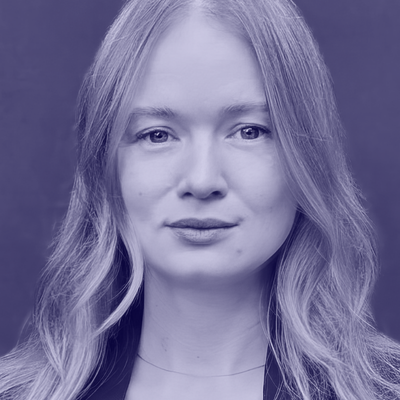
Ewgeniya Lyras, Author, Video Producer & Visual Artist
Europe as Community: What Europe Must Protect Inside Its People Before It Can Build Anything Durable Between Them
Until recently, the question of who to be was primarily determined by birth, trade, or need, and often the need for survival settled it before it could surface as a question. Throughout history, identity has been tapped into as an instrument for profit, a weapon, an illusion to win the hearts of the masses, a scaffolding on which one attempts to find one’s purpose. A self has been assembled through fear, manipulation, and trends. Today, we can’t talk about identity outside the technological revolution of the modern day. AI opens up radically new opportunities, not only for us as a civilisation but for us as individuals. It facilitates a new dimension of individual being.
We were never freer, never had as many options of who to be, what to learn, how to look, and what communities to belong to — and we were never easier to assemble. This is neither a new freedom nor a new threat, but at this scale, both become new. To navigate this dimension, we may need to rely on a new — or rather ancient and forgotten — internal mechanism, one that is both fluid and anchoring. One that may require us to deconstruct ourselves, to reconnect with ourselves and create a new internal operating system that serves our transition into a new age. I’m talking about a controllable presence that bypasses assumptions, outside noise, and rigid structures, and protects our genuine experience.
When new identities, experiences, and meaning are manufactured as mass commodities, the capacity to know what is true for you, what genuinely moves you, what you actually want versus what you are being directed to want, becomes one of the most valuable skills of our time. Not only because it protects you from being sucked into a path that isn’t yours, but because new liberties and technology open up enormous potential for exploration and self-realisation. Conversely, when the connection to the self erodes, it causes disorientation and leaves a vacuum. You reach for whatever is being offered, whatever is loudest and most accessible. But it doesn’t fill the void inside, and it doesn’t construct the right connection; it creates more anxiety and more emptiness.
This is not a uniquely European crisis. It is the global crisis of self-authored experience. Yet Europe, with its extraordinary concentration of cultural institutions, festivals, and artistic traditions, has the architecture to respond to it especially well. What it requires is a different understanding of what that architecture is for. Not merely the display of finished excellence, but also the transmission of living practice. Not the celebration of what artists have made, but the protection of the conditions under which they make it — slowly, and without the pressure of commercial viability.
Recently, I stood before one of Anish Kapoor’s Voids. Its light-devouring black, shaped into a circle, both pulled and repelled me with its passive yet intruding omnipresence. Passive because it didn’t try to do anything; it didn’t even try to be itself. Intruding because it wasn’t just sucking the light out of the room but from the inside of me, pointing at my own void. Omnipresent because in my experiencing it — as it bent me, merely as the infrastructure for its passing — it continued beyond my thinking of it and beyond what I know as me. It passed through and stretched me with it into the layers of the human condition that don’t end in a human but leak beyond, pointing to a fundamental quality of existence. In that moment, I felt I was both the space that facilitated the experience and the process that occurred within it — someone with no fixed story or identity, no purpose, but an unshakable sense of belonging. And belonging not to somewhere or something, but belonging within myself. That sense of belonging wasn’t latching onto the attributes of my identity. On the contrary, it rendered them imperceptible and merged me into itself.
I tried to imagine what explorations, contemplations, and real-world experiences preceded these final pieces — and how much searching, questioning, and friction had to happen to culminate in an array of physical objects that moved me into a state in which my perception gained new plasticity. How much could the journey of one dedicated traveller teach us?
We usually regard artists when we encounter their completed works. But after the war for attention has left us disoriented, staring at the vastness of opportunity with emptiness and anxiety, artists may offer expertise that provides more practical value than their final pieces. What artists can teach us is attention, presence, and honesty. Honesty starts with the choice to become an artist in the first place. One does not choose this path hoping for a comfortable life. Persevering as an artist is another test. It requires commitment to what nurtures and expands inner depth and connection, often at the expense of security. An artist’s daily practice consists of training one’s intuition, testing what is true and what is not for oneself through constant friction between the outside world and one’s interior. It is about recognising what belongs to one’s truest perception and experience of reality.
That recognition is the most important resource Europe currently has, but nurturing it requires a radical shift. Europe’s cultural policy has measured its investment in arts and culture primarily through economic output — the cultural and creative sectors add to EU GDP and provide millions of jobs across the continent. These contributions are real, and they matter. But they measure what culture produces for the economy, not what it produces inside people. And what it produces inside people — when given the space to be slow, non-commercial, genuinely investigative — is the capacity to know what you feel. To train attention. To resist noise. To find the direct bond to yourself.
What’s missing is more space for people to meet artists and witness the living practice: for artists to share not their polished products but their love, their process, their routines, their how. For the artisan to be seen at work. For the writer to speak about what writing feels like from inside. For the musician to describe what they are actually listening to. The goal is not to inspire others to become artists but to nudge them to take the first steps toward themselves. Because when someone speaks with genuine love about something they are passionate about, something they couldn’t have stopped doing even if they tried, something in the person listening recognises it. That recognition is the first step toward recovery from feeling overwhelmed and numb, and toward training your own attention. Toward finding the direct bond to yourself. Toward becoming, over time, a person who is less scattered, less available for manipulation, less attached to noise. A person capable of participating in something that deserves to be called a community.
A community, in turn, cannot be built on people who are struggling to know who they are. It can only grow sustainably from people who have been given the conditions to find their bond to themselves, to something they love doing, to the quality of presence that allows them to recognise each other as beautifully multifaceted, magnetically different, fully equal, fully human.
If Europe wants artists to contribute to its project, it should ask not only for advocacy but for depth. It should create conditions in which serious, uncompromising work can be made and encountered not only as finished objects but as living processes. It should bring artists’ studios and artisans’ workshops and writers’ practices into the conversation, not to display their products but to share their love. And politicians, if they are serious about this, should not only attend opening nights but also witness the process and try to feel what it does to its practitioner. The case for culture is not only that it deserves recognition as a sector with its own logic and its own value. It is that it performs a function that few other things in European society perform: the slow, immeasurable cultivation of the inner conditions on which everything else depends.
